The Unfolding of BRAVO! COMMON MEN, UNCOMMON VALOR
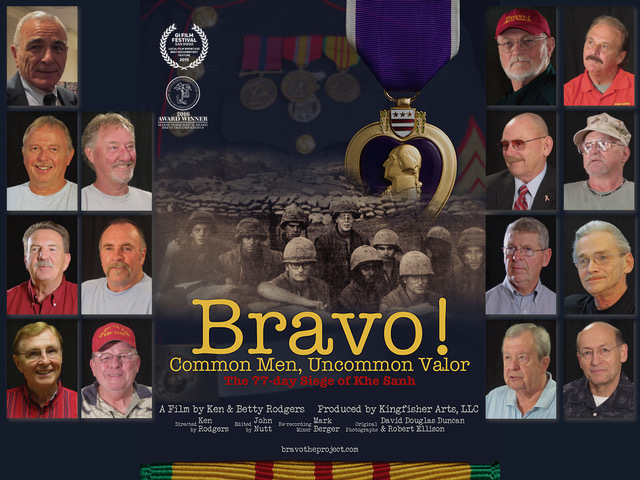
By Ken Rodgers, with Betty Rodgers
I’ve always been compelled to tell stories. My father once told me I came from a long line of world-class bullshitters. In my family, stories carried history and myth and laughter and pain.
When I arrived in Vietnam in March 1967, I joined Second Platoon, Bravo Company, 26th Marine Regiment at Hill 55 and remained in that platoon my entire tour of duty.
When I left Khe Sanh around the first of April 1968, I rode a CH-46 loaded with body bags to Dong Ha where I spent the first night on my long journey home.
When I stepped off the chopper, I looked back towards the west, towards the Annamite Mountains, towards Khe Sanh, and thought, That’s one hell of a story.
When I got home, I tried to talk about my Marines, my war, the Siege, the horror, the courage I’d witnessed, but nobody seemed interested in listening. So, like many Vietnam veterans, I shut my mouth.
But the story never left my mind, and it festered.
In 1993 I began to study creative writing, and immediately poems and stories about my experience at Khe Sanh, in Vietnam, in the USMC showed up in my thoughts, often barging into something I was writing that had nothing to do with war.
I also wrote about the war intentionally. I wrote short stories, long fiction, essays and poems based on what happened to me at Khe Sanh.
But I never felt that what I created adequately expressed what I was feeling.
In 2009, my wife Betty and I attended the Khe Sanh Veterans’ reunion in Denver, Colorado. That year, a lot of men who served with Bravo 1/26 attended.
One afternoon, a bunch of us Bravo Marines were sitting around a big table reminiscing about our experiences during the Siege.
Betty said to me that when we all got up and went home, the stories we were telling would go with us, and no one outside our group of Khe Sanh survivors would ever know the truth about what that experience was like: the mortars, the artillery, the snipers, the ambushes, the firefights, the lack of chow, no showers, and no mail at times. The loss, the bravery, the fear. The dark humor. And the horror.
I said, “That’s true.”
She said, “We need to tell the story.”
I said, “You better see what the Skipper, Ken Pipes, has to say.”
She went to Ken and they talked and he gave his blessing and wished us good luck and said that other folks had tried to tell the story of Bravo Company during the Siege, and it hadn’t worked out so well.
On the way home, she said, “I think we should make a documentary film.”
I thought about that. We knew nothing about filmmaking. I knew story and story structure, and I knew what happened to us at Khe Sanh. She was a damned good photographer who understood visual imagery and she had a lifelong appreciation of veterans and so many of us who grew up in households headed by veterans of World War II.
But it seemed like a pretty big job to tell the story right. Since I’d had so-so results in my attempts to write about the war, I felt like if we were going to tell it, it had to be good enough to get a lot of people’s attention. I didn’t think it would happen.
So I said, “Okay.”
Here I need to say that what we created, Betty and I, with BRAVO! was her dream as much as mine, and she was responsible for so much of the hustle and grind that occurred as we dug into the project. People say that it’s my film. It’s our film, hers and mine, and the men who had the courage to sit down and talk to us, to be filmed, and exposed at times to the whole world. It’s their film and a film for so many more who lived it and other horrors, and even for family members of warriors from multiple conflicts.
We lived in Boise, Idaho, at the time and Betty found a group called Idaho Media Professionals. There were a lot of media companies involved who primarily made training films and marketing materials. There was one Academy Award winner and a screenwriter who had worked in Hollywood.
We joined and started soaking up all the info we could and received a lot of help and some atta-boys, so off we went to make a film.
Betty contacted the Marine Corps Heritage Foundation and asked if they had any grant money available for a project like ours. They were interested in the project and gave us seed money and some advice on how they thought we should go forward. I had planned to go to Nam and film the terrain where the battle was fought, but the gentleman heading the Heritage Foundation, General Ronald Christmas, felt we didn’t need to do that.
He also volunteered help from the Marine Corps History Division where we could dig into all the background info and B-roll stuff that is so important to film.
Betty and I had no idea how to begin other than the fact that we knew we needed to get the interviews done as soon as possible because several potential interviewees were fighting a battle with the results of Agent Orange exposure. So, we developed a set of questions based on my memories of the Siege, hired a videographer, Mark Spear, and interviewed me first to see what if felt like to answer questions about events and emotions I didn’t really want to dig into too deeply.
Then we contacted every Bravo Company Khe Sanh vet we could locate who had served during the Siege, explained what we were doing, and asked if they would be willing to be interviewed. Some immediately said yes. Others would not be available at the time we were planning to conduct the interviews during the 2010 Khe Sanh Veterans Reunion in San Antonio. Some weren’t interested. Some didn’t respond.
Because some had said they wanted to be interviewed but wouldn’t be at the reunion, we wondered if we should go on the road.
July of 2010, we—along with Mark Spear and his camera gear—flew to San Antonio and interviewed nine men: Mike McCauley, Frank McCauley, Lloyd Scudder, John Cicala, Michael O’Hara, Ron Rees, Peter Weiss, Steve Wiese and Ken Pipes.
We set up in a room at the hotel and over two days, I conducted the interviews. Some of the men I knew well, some I barely knew, and some of them I didn’t know at all. What came out in their responses amazed me. I was there through the whole damned Siege, but so much of what I heard I’d never heard before, and of course a lot of it was personal emotions and reactions. When we left the reunion and came home, I realized we had a tremendous amount of profound stuff about war and rage and fear and loss.
Then we returned to Boise and had all these powerful, revelatory, anguished interviews, hours and hours. What to do now?
But there were still men out there who wanted to tell their story, plus we needed to get to the Marine Corp History division at Quantico, Virginia.
One of the men I wanted to interview, Dan Horton, called me right after we had returned to Idaho and told me, “If you are going to interview me, you better come now.” He had cancer and I suspect that though he never told me directly, he foresaw his end which came not long after he shared his story with us. Dan died on November 10, 2010, a fitting day to go if a Marine has to go.
So, we loaded up our stuff and headed east through Montana, North Dakota, and Minnesota into Michigan where we rented some lights and filters and interviewed Dan in our hotel room. Then we went to visit Cal Bright for his interview at his home. In both cases, we were our own techs, and we struggled with those lights and the sound. But we got it done.
Then on to Washington, DC, where we based with Betty’s cousin for the next month and off we went to Quantico and met Dr. Charles Niemeyer, Director of the Marine Corps History Division at the time, who opened archives and gave us some research help. We got some video footage done by the Marine Corps at Khe Sanh during the Siege, and dug into their audio recordings and discovered a lot of discussion that was taped during the Siege, a lot of them with personnel from the 26th Marines and even Bravo 1/26. It was thrilling to find the voices of some of the men we had interviewed!
Dr. Niemeyer then sent us to the National Archives in Bethesda, MD, where we spent hours and days in the bowels of information stored there. We got videos, we got pictures, we got other info. We worked from early to late, undergoing rigid security checks to make sure we weren’t stealing anything. There were a number of instances where we had no clue how to find or deal with the resources and other people who researched there kindly offered to help us out.
At the Wall, we photographed the etched names of Bravo Marines killed at Khe Sanh. We went to the Iwo Jima Memorial, and we tried to get some sleep in the humidity and the heat. We simply researched, researched, researched. On our return trip to Boise, we interviewed Tom Quigley, Ben Long, and Ken Korkow. By then we had decided we could use some tech help, so we hired some pros when we interviewed Tom and Ken.
When we got home, we thought, We have all this wonderful material. What do we do now?
We considered buying a fancy desktop computer and installing Apple’s film-editing software and making the film on our own, but I was advised against that idea by people who knew that the learning curve was daunting. We wanted to get the film out there sooner than later.
We talked to a number of film editors in Boise and didn’t think that they fully understood what we were trying to do.
Something I learned in Nam: sometimes you just have to be lucky.
After our interviews were completed, we headed down to Arizona and my old hometown. While there, Betty went into the office of the local newspaper and explained that one of their hometown boys was making a film about his Vietnam experience. He was available for an interview if they were interested.
And they were, and the article got picked up by the Associated Press and a “Hollywood” film editor from the Bay Area and his wife were in Tucson visiting their daughter and both read the article.
He was a Vietnam veteran named John Nutt and had worked on a lot of great films during his long, illustrious career; films like Apocalypse Now, The English Patient, Munich, and he had won a BAFTA for Amadeus.
John googled us, called and asked for “Ken Rodgers, the filmmaker.” Betty and I laughed because we didn’t yet see ourselves as “filmmakers.”
He wondered if he could help us with the film because he’d always wanted to work on a documentary about the Vietnam War. One thing led to another, and we began by giving him the interviews. He asked me to go through and transcribe each one, and I wore out a DVD player going back and forth, back and forth, to get who said what and when just right, and it was the best thing because by the time I finished hours and hours of recorded interview footage, I knew where the high spots were.
John told me to create a paper script with the film as I envisioned it, so I made a script and John gathered up the interviews, along with all the info we got from the National Archives and the Marine Corps History Division.
We also procured film clips for him from CBS that were made during the Siege, and Steve Wiese gave us actual tape recordings that he had sent home to his mother from Khe Sanh. And we used photos by David Douglas Duncan, a storied Marine and photographer who took some of the most iconic photos during the Siege, and for an added bonus, Betty got to have a phone conversation with him while he was at his home in France.
During the Siege, a young photographer roamed through the trenches taking photos of us when we were at our most vulnerable, our most frightened, and he went out with only his pistol and camera when the men on the Ghost Patrol were trying to return from that ambush. He died not long after that on a plane coming into Khe Sanh after he’d gone to Saigon to turn in his photo negatives. In a subsequent issue of Newsweek Magazine, our agony, our travail was displayed to the whole world from the images captured by Robert Ellison, many of which we were able to include in the film.
Then we waited while John made the first cut. The first time we watched BRAVO!, we were amazed, but at certain points I sat and thought, You can’t do that. Then I remembered that we had told John that he was the professional so he should just go for it, and so he did.
The results were gut-wrenching, powerful, sad, funny in places. We had a film that I felt adequately and accurately portrayed what I went through, what so many of us went through during the Siege of Khe Sanh.
But we weren’t done. We needed to mix the sound to hone it to a perfect pitch, and John got us into George Lucas’ Skywalker Sound in Marin County, California, where four-time Oscar winner Mark Berger rendered the final remix of our film.
Betty and I stayed at the ranch in the Fellini Room at the residential quarters, and we sat in on two long days with John and Mark as they worked through BRAVO!, looking on computer screens at the sound frequencies, raising, lowering, softer, louder, occasionally arguing about why did you do this and that, and when they couldn’t come to a satisfactory conclusion would turn and look at Betty and me and ask what we thought, and sometimes we really had no idea what they were talking about…or couldn’t hear the difference.
Finally, we went to the 2011 Rochester, Minnesota KSV Reunion for the real test. We showed it first to the men in the film, and thankfully they didn’t hit me or shoot me or curse us, and it was powerful and emotional—that two hours in that room—with those men and their wives. The Skipper proclaimed that we couldn’t have done a better job.
Having passed that benchmark, we then screened BRAVO! to an audience of men and women and other guests who were at the reunion—a good-sized crowd—and the majority of the response was admiration for the dialogue it stimulated afterwards. We were also thanked for telling an authentic story of the Vietnam War, not a story that had been influenced by Hollywood. By then, we were confident we had a film that hit the mark.
Since then, we have traveled all over the US screening the film in homes, in businesses, in VA facilities, in prisons, at universities, in theaters. The film has been watched on PBS stations, DVD, and Amazon Prime thousands of times, and is still being watched.
BRAVO! won the 2015 Best Feature Documentary Award at the GI Film Festival in San Diego, the 2016 Marine Corps Heritage Foundation Major Norman Hatch Award for Best Documentary, and for Ken, the 2016 National DAR Founders Award for Patriotism.
All through this process, our friend, photographer, and graphic artist, Mike Shipman, has helped us with online technical issues, website building, and graphic design including our cover image. Our esteemed Associate Producer, Carol Caldwell-Ewart, helped tremendously with communications and crowd-funding, and author Pamela Kleibrink Thompson wrote dozens of articles that have been published around the country from Costco Connection to Vietnam Magazine.
A brand new article by Danny Cook about BRAVO! was just published in the 2026 September/October issue of the national VFW Magazine. Here is a link: https://www.qgdigitalpublishing.com/publication/?i=867814&p=52&view=issueViewer
We could not have done any of this without the fervent and financial support of Bravo Company, 1/26 men, many other Khe Sanh Veterans, friends, family, veterans organizations, and even strangers who believed in the importance of this film. And let’s not forget the USMC.
Betty and I started this project by wanting to preserve history, but it quickly grew to be much more. It became a way of giving Vietnam Veterans a voice, a gift from the heart to fellow Khe Sanh Veterans, a way of healing for many Vietnam veterans and family members, and as a way to help our nation’s citizens understand what we are asking of our young men and women when we send them off to war. What happened at Khe Sanh forever altered the lives of those who survived and, when we came home, weren’t loved with open arms by our fellow citizens. And we went mute, for the most part. Then, 42 years after the Siege of Khe Sanh, the men of Bravo Company, 1/26, finally told their story. And I told mine.
Reference:
https://bravotheproject.com – Website
https://facebook.com/bravotheproject – Facebook
https://www.qgdigitalpublishing.com/publication/?i=867814&p=52&view=issueViewer – VFW Magazine, September/October 2026
https://www.youtube.com/watch?v=YfnXJoKOnDE&t=289s – Interview of Ken, Betty and Steve Wiese
https://www.youtube.com/watch?v=kLVctdXJaRI&t=184s – Interview about the making of BRAVO!