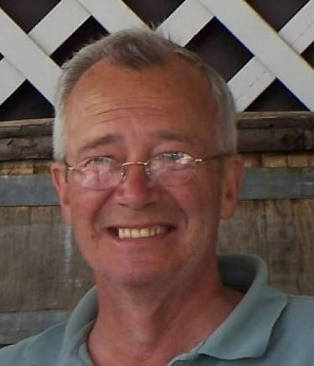
Jacobson Jr., Russell Harold
January 9, 2015 – Nov. 7, 1946
Russell Harold Jacobson Jr.
Russell Harold Jacobson, Jr., age 68, died on January 9, 2015, at home surrounded with his family. He was the devoted husband of Margaret Mary “Peg” (Johnson) Jacobson. Born in New London, CT on Nov. 7, 1946, he was a son of the late Russell H. and Marion A. (Odell) Jacobson. He was educated in CT and was a graduate of Norwich Free Academy, University of CT, Quinnipiac and Yale University. For most of his life Russell worked as a Pathologist, working at the University of Connecticut and later at Cape Cod Hospital in MA. He moved to Plymouth 10 years ago after residing in Avon CT for many years and more recently Harwich, MA. Russell enjoyed woodworking, archeology, boating and fishing. He was “Always in search of the big fish”. He was an avid reader and was a history buff. He will always be remembered for his great sense of humor and quick wit. Besides leaving his wife “Peg” of 46 years, he was the loving father of Andrew and his wife Jackie of Simsbury, CT, Matthew and his wife Meri of New South Wales, Australia, and David and his wife Kristin of Plymouth. He was the beloved brother of Fredrick of Berlin, CT, Robert of Florence, SC, and Beth Champlain of Oakdale, CT. He was the cherished grandfather of Wyatt, Brody, Sam, Tilly, Elke, and Eli.
Russell Harold Jacobson Jr.’s life experience at Khe Sanh, RVN as told by his son David Jacobson.
My father, Russell Harold Jacobson served as a Navy Hospital Corpsman, HM3, attached to Echo Company, 2nd Battalion, 9th Marines. On the night of March 16–17, 1967, he was on Hill 861 during the Hill Fight there. The battle was intense and many Marines fell. The NVA had professionally prepared their bunkers in depth, with fields of fire and camouflage beyond anything the Marines had ever experienced. It became a blood bath for the trapped Marines who continued the assault as assigned. But now with the additional mission of retrieving their wounded and dead buddies.
When the battlefield at last became quiet, the senior Marine in the area, Sergeant Olsen, focused his efforts on getting the wounded out. He called for his two corpsmen. Then, someone told him that both Docs had been hit. In fact, Doc Jacobson lay among the seriously wounded. He had been hit more than a dozen times while moving up and down the fire-swept Hill 861 trail treating and pulling casualties to safety. The damage to his body was devastating — severe wounds to his hip and kidney area, his legs and feet. The “Doc” was finally felled when, yet another bullet ripped into his right hip, destroying it and immobilizing him.
As a pain-wracked Jacobson lay in the elephant grass, an NVA machine gun team set up their weapon with his head and operated there for forty-five minutes. Basically, using his body as a shield Marines would hesitate to destroy. Published accounts of the battle describe my father and another wounded Marine lying exposed for an extended period while enemy forces remained dangerously close, as the fighting continued around them.
Other Marines eventually risked their own lives under fire to recover my dad and the wounded to move them toward evacuation helicopters. Two of those men were Earl Chittenden and Herbert Thompson, who helped get my father to the evacuation helicopter during the chaos of the battle. In a 1967 letter, Thompson later credited my father with helping save the lives of Marines who otherwise might not have made it out.
When the NVA pulled out, one of them tucked a grenade between Dad’s pack and his flak jacket. This to kill or maim the Marines who they knew would come to recover and treat their wounded. The grenade blast took one of his kidneys. The flak jacket saved his life! When the Marines found Dad, there was no pulse. He was loaded onto the Medevac as a casualty, believed to be dead.
However, he was still alive.
His actions that night are documented by name in Edward F. Murphy’s The Hill Fights (Presidio Press, 2003), pages 44–45. The other corpsman, Doc Francis Arthur Benoit, had taken shrapnel in both arms and legs in the opening moments of the attack but had ignored his considerable pain to continue treating the others. He was posthumously awarded the Navy Cross for actions on the same hill, the same night, under the same conditions as Dad.
My father came home. He raised a family. Like many Vietnam veterans, he rarely spoke about the war. Growing up, we knew he had been badly wounded and carried lifelong injuries from Vietnam, but he never centered his identity around it. He never bragged. In fact, he would often say he was one of the lucky ones.
The war physically followed my father home for the rest of his life. The wounds he sustained on Hill 861 led to surgery after surgery over many years — a constant physical reminder of what that day had cost him. He spent roughly a year recovering at Chelsea Naval Hospital in Massachusetts. Only later in life did we begin to understand how extraordinary, and how traumatic his experience truly was.
Yet despite the pain, the disability, and the long years of recovery, he remained remarkably active, compassionate, and engaged in life. He eventually built a career in medicine as a physician, assistant and pathologist.
None of that would have been possible without my mother, Peggy. She was a nurse, and in many ways his care became a lifelong extension of that calling. She stood by him through decades of recovery, surgeries, and the invisible wounds that never fully healed — nursing him through long stretches of recovery right there in our home. My father, never one to miss an opportunity, would tease her from his hospital bed by calling her “Nurse Ratched”. She took it in stride every time.
That was who he was. Even after everything his body had endured, he never lost his humor. When people would see his scars and injuries and struggle to find words, he would wave them off with a grin and quote Monty Python — “tis but a flesh wound” — like the Black Knight who kept fighting after losing every limb. It always got a laugh. And somehow it said everything about him that words couldn’t.
Along the trail, he was struck by Agent Orange-related illness — the war’s final wound on him. Agent Orange and Vietnam:” The Gift That Keeps on Giving”.
Looking back now, I realize how much we learned simply by watching how he carried himself. He taught us that while people cannot control the terrible things that happen in life, they can control how they carry it forward. He treated people with kindness, humility, patience, and compassion. One message written after his passing described him perfectly — “He was slow to anger and quick to forgive”.
He had a favorite quote he lived by. Ralph Waldo Emerson’s definition of success: to laugh often and love much, to appreciate beauty, to find the best in others, and to know that even one life has breathed easier because you have lived — that was to have succeeded.
That was my father.
He never used his suffering as an excuse and never wanted attention for what he had endured. Like many veterans, he carried much of the war internally and rarely discussed it in detail.
When my father passed away about eleven years ago from an Agent Orange related cancer, it was another painful reminder that for many Vietnam veterans, the war never truly ended.
Right now, our family is simply trying to preserve his story and the memory of the Marines and corpsmen who fought and died alongside him during those terrible days on Hill 861.
I should mention that everything in this letter is drawn from actual military records, eyewitness accounts, published historical material, veteran interviews, and family documentation. I intentionally left citations out because I wanted this to read as a human story rather than a research paper, but I do have supporting material for everything described here and would be happy to share it if useful for KSV purposes.
David Jacobson
Son of HM3 Russell Harold Jacobson Jr